Author: John Tough

Why NASDAQ acquired a carbon removal marketplace

Why NASDAQ acquired a carbon removal marketplace

With net zero emissions targets now the topic du jour across the corporate landscape, there is suddenly a ticking time bomb for these same corporates to neutralize their emissions at the specified 2030-2040 time frames. Most firms now realize that they won’t be able to fully eliminate hydrocarbons from their supply chain or materials. So, the next step for these corporates is to think about what other investments they can make to counter their carbon footprint. Enter the (usually voluntary) carbon removal marketplaces or renewable offset marketplaces.

There are a number of marketplaces that serve this need, but an issue for mass-market adoption has been:

a) Credibility of the project providers and the scale of offsets (over-promising or dubious metrics)

b) Technical exclusivity of the offsets (many projects are sold multiple times)

The above issues have caused for “greenwashing” and a slight distrust in this market that ultimately yields a highly unpredictable price on carbon removal or offsets. And uncertain prices keep the main customers (corporates, primarily) on the sidelines. The market needed a credible middleman/marketplace creator to accelerate adoption.

Enter NASDAQ

This is where Nasdaq’s entry into the space makes a lot of sense. Nasdaq manages one of the most complex, high volume transaction marketplaces in the world.. a stock exchange. Yesterday, Nasdaq announced the acquisition of Puro Earth and immediately brings the entire Nasdaq customer base (both the listed companies and the investors), the market-making technology know-how, and accreditation to the carbon removal ecosystem.

Who is Puro Earth?

Puro.earth, a leading marketplace for carbon removal. Puro.earth is the world´s first marketplace to offer industrial carbon removal instruments that are verifiable and tradable through an open, online platform. The platform already provides carbon removal services to some of the world’s leading corporations, including Microsoft and SEB.

Why could this be a smart deal?

The NASDAQ corporates will immediately trust that Nasdaq can solve many of the existing carbon removal issues. I am assuming that Nasdaq can leverage existing technologies and securities packaging techniques to provide accreditation and exclusive attribution for each carbon removal project.

Once there is greater comfort in exclusivity and attribution of projects, more buyers will enter the market. This will cause the market to reach a near-term steady-state supply/demand price structure. This price confidence will then enable more project developers (carbon sequestration, etc.) to initiate projects as the developers will have higher confidence in the RoIs for those prospective projects. Again, market settlements and price matching are a Nasdaq core skillset…

Net, a win for the ecosystem to see a true financial marketplace enter the carbon capture arena.

$7B deal shows how industrials are going to re-bundle… but this time with software

$7B deal shows how industrials are going to re-bundle… but this time with software

This deal wasn’t announced in late April so it isn’t exactly breaking news. But I have had more time to work through all of the ongoing dynamics in the supply chain for the energy and industrial transition.

There seem to be 3 key trends converging here:

  1. Rapid consumer / corporate interest in transparent supply chains and the need to definitively source materials in a responsible way
  2. Change in types of raw materials going into new products: minerals, other sustainable alternatives
  3. Movement from just-in-time to resilient supply chain planning, which includes onshoring manufacturing

These are all foundational changes. At the same time the OEMs are realizing that just being in the manufacturing arena is a race to the bottom on margins.

I haven’t covered a number of the industrial M&A events over the past year. But a great company that was riding all of the above trends was Blue Yonder, and earlier this year Blue Yonder was acquired for $7 billion by Panasonic. Why is this an example of the future of supply chain? As described by their press release, Blue Yonder uses machine learning to help companies manage supply chains that connect factories to warehouses and retailers. Panasonic, one of the largest battery makers in the world (for Tesla) wanted to move from contract hardware into software and higher value add services. Blue Yonder had $1 billion of revenue with $344M of ARR at year-end. That means that Panasonic paid ~7x revenue or 20x recurring software revenue for the business. Panasonic is paying this premium because Blue Yonder will begin to move Panasonic’s industrial presence more into the data and software verticals. Smart move. Manufacturers realize that they need data and controls from process sourcing all the way to endpoint delivery. Being a manufacturing middleman is a dying position of the past. This may cause us to see more industrials re-bundle – but this time with software – after decades of disassembling behemoth and disparate manufacturing units.

I suspect we are going to see more industrials or OEMs seek inorganic growth by purchasing firms with access to supply chain analytics or firms that enable access to one of the 3 key trends identified above.

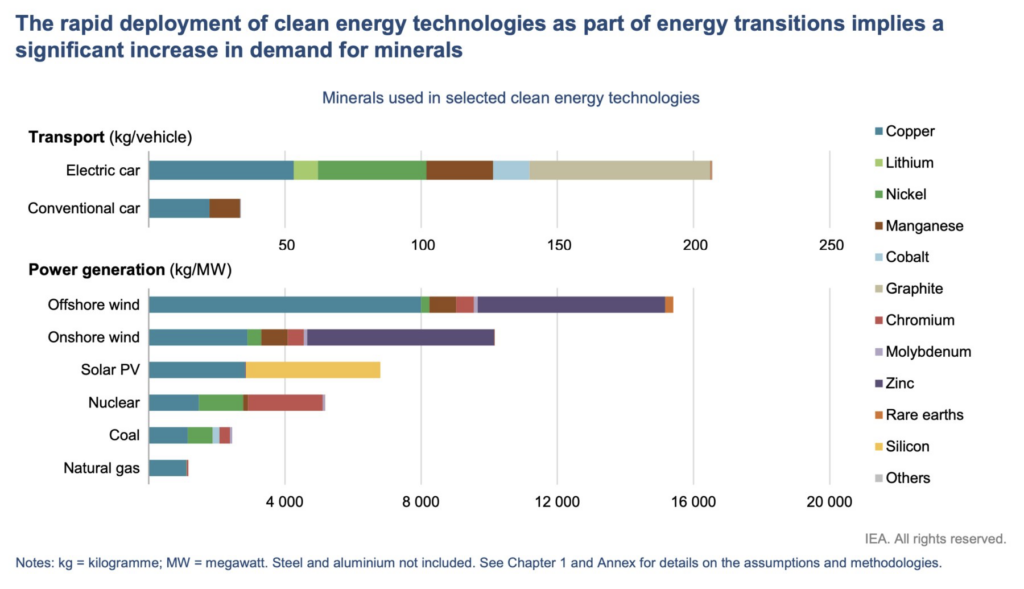
Energy Transition: Material Demand

Energy Transition: Material Demand

I saw this graph from the IEA a few weeks ago and it hit home on a topic those closest to the energy transition know: the energy transition is going to require a LOT of minerals.

These minerals are going to require a new approach to sustainable mining and a more prepared recycling strategy for the new energy pioneers. Supply chains will need to be reimagined and commodity price volatility managed. Finally, new geopolitical relationships and tensions will form. Net, certain parts of the carbon and new energy economy will look quite the same…

Simplicity and scale of agriculture

Simplicity and scale of agriculture

I’m up in Wisconsin for the long weekend and went out for a run this morning. We are surrounded by miles and miles that look just like this photo.

The agriculture industry is a surprisingly strong adopter of technology: seed technology companies, drone analytics for soil conditions, autonomous farming equipment, aerial and ground based sensors, climate-related insurance, and wholesale pricing platforms. Using that technology to streamline operations is almost table-stakes for farmers.

But stepping back, the simplicity, scale, and beauty of the agriculture industry is awe-inspiring. And we should continue to empower a more sustainable agriculture industry. A number of Energize companies serve the ag vertical and I suspect many digital solutions will continue to make a more positive impact for farmers, the goods they produce, and our more circular economy.

Stealing Defeat from the Jaws of Victory

Stealing Defeat from the Jaws of Victory

A friend used this phrase the other day: “They stole defeat from the jaws of victory”

I have seen this a few times in my career now. An individual or company was on their way to a great outcome. And keeping course and being heads down would have guaranteed the positive outcome. But emotions ran high or distractions came in and everything crumbled right before a defined successful event.

The individuals that achieve success usually are the ones that just keep on doing the same things that got them to the goal line. These same individuals also find ways to channel the anxiety or uncertainty into other productive methods. Super simple but this goal line slip-up happens more often than you think and it is painful to see unfold.

Jupiter Intelligence’s growth covered by Washington Post

Jupiter Intelligence’s growth covered by Washington Post

Jupiter Intelligence is a climate risk technology and analytics platform. Energize initially invested in the company in Q1 2019. We invested in Jupiter because we truly believe in Rich Sorkin and Eric Wun’s vision for the future of climate risk. As covered by Jeremy at the Washington Post yesterday, Jupiter’s vision and product are no longer a future requirement. Rather there is 10x year over year increase in demand for the company’s technology platform. Some snippets below:

Business booms at climate risk start-up as threat from extreme weather grows

By Jeremy Deaton – May 27, 2021

For most companies, the end of the pandemic has meant slowly getting back to normal. For Jupiter Intelligence, a climate risk start-up with headquarters in Silicon Valley, the recovery has led to a massive surge in business.

Jupiter helps companies gauge the threat that climate change poses to their bottom line, and it has seen a rush of new clients as business leaders look to the looming threat of extreme weather. Chief executive Rich Sorkin said Jupiter booked more than 10 times as many contracts in the first quarter of 2021 as it did in the first quarter of 2020.

“I think that the pandemic, for us, was a bit of a double-edged sword,” he said. “On the one hand, we had this near-death experience. On the other hand, once people got past the pandemic, they were like, ‘Oh, what else is there like this that we’re not worrying about that we should be worrying about?’ And climate change is at the top of that list.”

“It’s just like cybersecurity 10 years ago, when no one knew what cybersecurity was,” Sorkin said. “Now, there isn’t an entity on the planet that doesn’t have a cybersecurity or security solution that, in large part, depends on some third-party cybersecurity company. And this is going to be just like that.”

1 Year with Mark Tomasovic

1 Year with Mark Tomasovic

I am a few days late here, but we had a fair amount happening over the last week!

Last week marked the one year anniversary of Mark Tomasovic’s start date with Energize. If a few years ago you had told me we would hire an Exxon chemical engineer as an investment Associate I would have thought you were crazy.

But Mark is a special individual. He is humble, thoughtful, and constantly learning. He wanted to change careers but join a team that respected both sides of the energy transition – and we were lucky to hire him. He is helping us identify the best practices of the carbon economy and bring those insights to the new energy economy. His network is additive to Energize’s existing relationships and his perspective on market trends, investments, and team building has made us stronger. He is also our lead Twitterer …

The Energize team: our firm, our portfolio, and our LPs are all the better with Mark on our side. His slope of learning is VERY high and I expect you all will see even more positive updates from him over the coming year.

The Reason for Energize’s Growth Fund

The Reason for Energize’s Growth Fund

Yesterday Aurora Solar announced their $250M Series C. When Energize led our ~$14M investment in 2019 we most certainly did not imagine this growth potential for Aurora and the solar industry at large. The industry/company is hitting new highs and COVID forced firms to accelerate digital adoption.

Beginning around Q3 last year we started seeing the near-term TAM across our portfolio begin to get bigger as demand levels leapfrogged a number of years… creating more immediate scale. As a result, the upside case for our portfolio and thesis in general began to increase. Like in the movie JAWS, we realized we “needed a bigger boat”. Our best companies can and likely will reach higher commercial traction than we projected and require more capital to meet the growth opportunities that lay ahead of them. With that knowledge, we went into action and raised our first Growth Fund, alongside hiring Kevin Stevens to manage that existing and future opportunity.

Aurora Solar is one of our (currently) four investments in this first growth Fund. Kevin wrote yesterday’s blog post on our continued investment into Aurora. In his post he talks about one of the main reasons for the new scale opportunity for renewables-focused software and I wanted to highlight it here:

A theme that can be seen across the renewable energy spectrum is hard costs on the decline. Solar is perhaps the best example of this trend, and we are seeing the decreasing cost of hardware create demand from consumers and businesses alike. Along with growing demand comes new challenges, such as accurate design and efficient permitting. The best solutions for these pain points? We believe it’s software.

Kevin Stevens, Principal at Energize, Head of Growth

As hardware costs have declined, software is now required to enable the scale of the renewable energy verticals. Now is “go time” and Energize is ready to serve this market from early commercialization through the growth stage.

Just in Time vs. Resilient Supply Chains

Just in Time vs. Resilient Supply Chains

A business school 101 class would tell you that excess inventory consumes cash flow and lowers the return on capital. Armed with that simple fact, an unquestioned business movement over the past decades has been the “Just in Time” (our “JIT”) supply chain. “Just in Time” means that firms are:

1) Using predictive or behavioral analytics to predict demand and order raw materials

2) Make the consumed good in real-time

3) Deliver to the end customer or distributor at nearly the exact moment the customer needs the product

With this movement firms are investing less in inventory and driving more profitability. In a steady state world, this JIT process can be a thing of beauty.

And this works, until the day it does not. And a number of consumer, social and political changes are beginning to reveal the JIT weakness.

Climate events are stressing the supply chain. See: McKinsey report on climate weakening the supply chain

Changing consumer preferences are stressing the supply chain. See: EVs and lithium ion battery shortages

International geopolitics is stressing the supply chain. See: computer chip shortage affecting automotive industry

Cyber attacks are stressing the supply chain. See: Colonial Gas Attack.

I am guessing the next generation of “best practice” will move from “Just in Time” to “Resilient Supply Chain”.

Resiliency will likely mean a slightly more costly supply chain structure. But this is a supply chain that won’t buckle with a single point of failure. It means investing in cybersecurity, climate resilience, materials alternatives and potentially more localized production. Technology and software will play a big role in altering our supply chain. This is an area we are focusing on at Energize.

Aurora Solar Raises $250 Million to Digitize Solar

Aurora Solar Raises $250 Million to Digitize Solar

The renewable markets are way way bigger than any of us expected… even those of us that are witnessing the growth first-hand. At Energize we are starting to see accelerating growth rates across the portfolio at revenue levels that usually succumb to scale. One of those success stories is Aurora Solar, and they have a big announcement today.

You can read their Forbes coverage here: Solar Design Startup Aurora Solar Reaches Unicorn Status or the Techcrunch coverage here: Aurora Solar Aims to Power the Solar Industry with a $250M Series C

Energize’s blog post is found here and the company’s press release is below.

Funding Round Led by Coatue Signals Market Interest in the Growing Solar Industry

SAN FRANCISCO, May 24, 2021– Aurora Solar, the industry’s leading software platform for solar sales and design, today announced it has closed a $250 million Series C funding round led by Coatue, with follow-on participation from existing investors ICONIQ, Energize Ventures, and Fifth Wall.

In just over two years, Aurora Solar has raised more than $320M. Today’s fundraise underscores the remarkable shift to renewable energy happening in energy markets around the globe, with solar being the fastest-growing source of energy over the past decade. This growth translates into jobs —by 2030, in the United States alone, the solar industry will need to grow from 230,000 to 900,000 people in order to meet President Biden’s goal of carbon-free power by 2035, according to the Solar Energy Industries Association. Software is the key to making solar installations affordable and accessible for both residential and commercial use cases.

Aurora enables solar companies to streamline the solar project lifecycle by making it easy to integrate disparate data sources, design accurate solar installations, and automate complex workflows. Using Aurora, solar professionals can accurately determine how many solar panels will fit on a property, forecast how much energy the solar system will produce, calculate how many batteries are needed for backup power, and show how much money their client will save by switching to solar.

“Our mission is to create a future of solar energy for all. The only way to reach that goal is to make it easy for solar professionals to design and sell solar remotely, and to make it affordable for consumers to understand and access the benefits of solar” said Sam Adeyemo, Aurora’s co-founder and CRO. “This funding will help us accelerate our vision, as more solar companies choose to grow their business using digital and remote solutions rather than manual ones.” 

Since 2010, the install costs for photovoltaic solar have already dropped by 70%, and reducing soft costs (i.e., non-hardware costs associated with going solar) through digital solutions like Aurora offers the biggest opportunity to continue cutting down the price of both residential and commercial projects.

“Residential solar is set to grow significantly over the next decade,” said Jaimin Rangwalla, Senior Managing Director at Coatue. “Aurora has the potential to unlock an inflection in this growth through lowering soft costs, such as installation and permitting. We believe Chris and Sam have proven themselves to be exceptional operators and have built the leading software business in this category. We are excited to partner with them on the next phase of this journey.”

“We see an incredible opportunity to expand the market for solar software and make it accessible to anyone on the team, from sales and marketing to design and operations and more,” added Chris Hopper, co-founder and CEO of Aurora Solar. “Working firsthand with solar professionals in communities around the globe has given us a front row seat to the explosion in the solar market and the economic opportunities it is creating for more jobs, lower costs, and a greener future for us all.”

Aurora Solar will use the investment to expand its product roadmap, continue to attract more talent across all teams, expand sales and customer support, and build its leadership team to help scale the company.

To learn more about Aurora Solar:

  • Register for Empower Solar, our free, virtual event on June 8th and 9th where we bring the solar industry together to share knowledge, expertise and insights. We will also be unveiling some of our biggest products to date here!
  • Visit our career page to learn more about opportunities with our team.

About Aurora Solar Inc.

Aurora Solar is a fast growing technology company that enables solar professionals to remotely design and sell solar and storage projects. Aurora Solar was named Rising Star Company by S&P Global Platts in 2020. To date, over 5 million solar projects have been designed in Aurora globally. For more information, visit www.aurorasolar.com and follow us on Twitter @AuroraSolarInc.