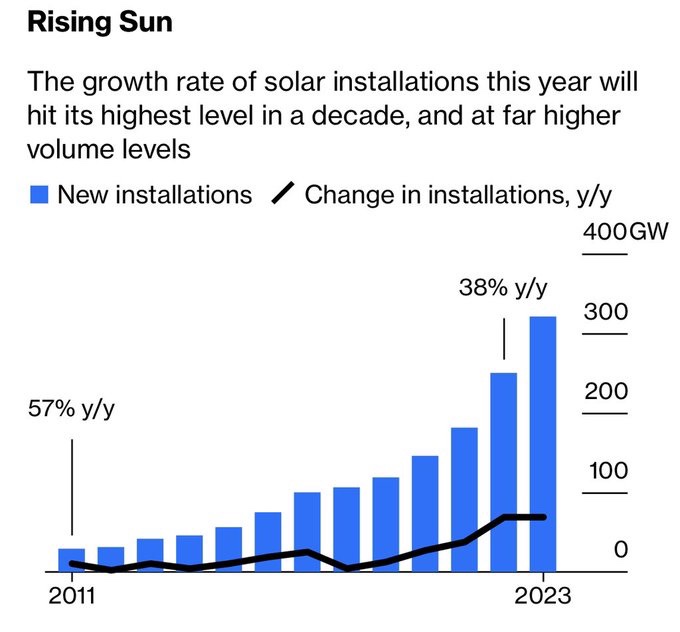
Bloomberg New Energy Finance recently released their 2023 global, mid-year forecasts. One of the most prominent charts is the continued growth of solar deployments. Outside of internet fiber, very few infrastructure type projects have ever grown this fast at this scale. And it’s hard to imagine any slowdown as costs continue to decline and decentralized resilience (solar and batteries) continues to gain front page prominence.
We are actively looking for investments that help enable this deployment. We have a few companies already serving the market… And want to find more entrepreneurs accelerating and serving this scale.
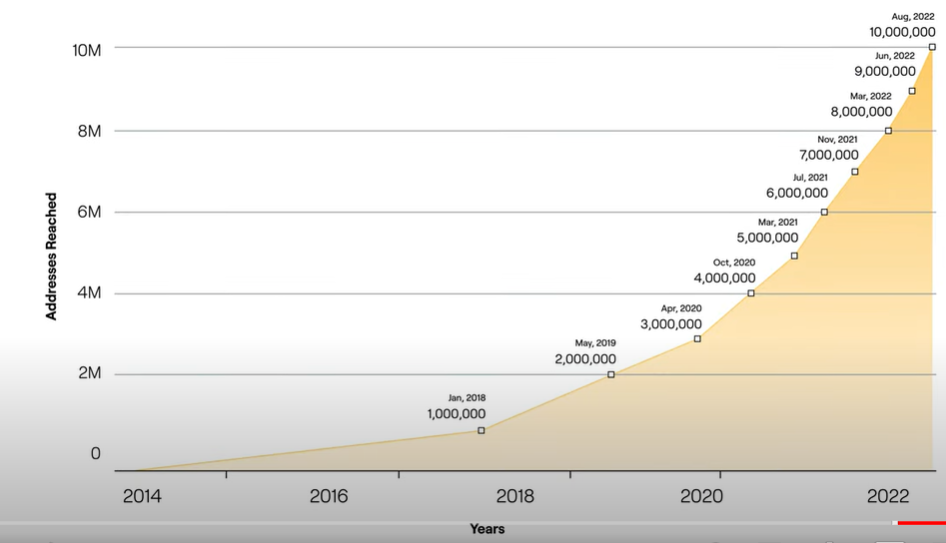
Energize is the largest shareholder in Aurora, the leader in the solar software design and sales market. They released the below chart just this week that shows the number of systems designed on their platform since inception. It took the company nearly 5 years for the first 1 million rooftop designs. Aurora’s software now does that level in less than 3 months, and the cadence is accelerating. This is a generational opportunity.
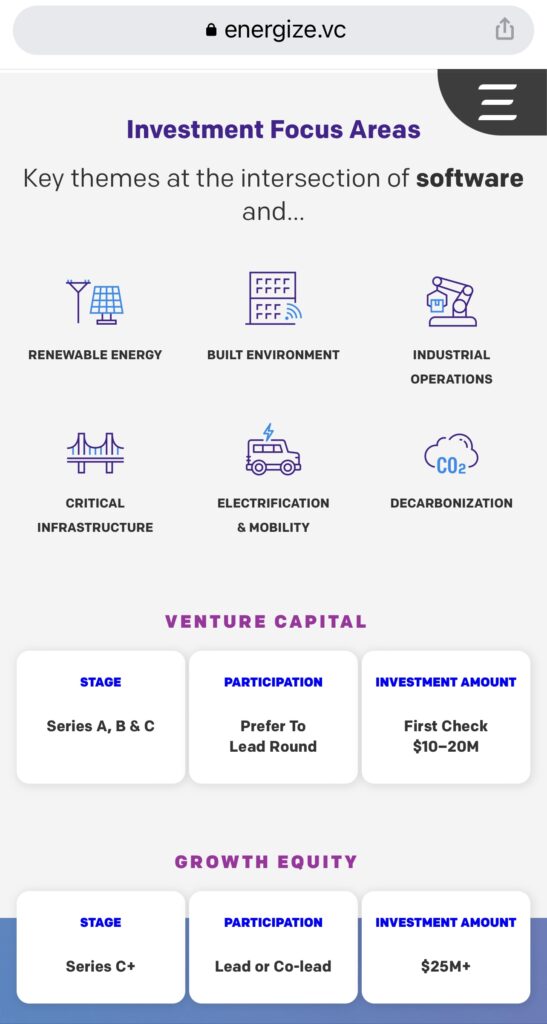
Team Energize recently updated our website to better present our focus areas. In the past we focused the messaging on the problems we believed digital technologies could solve, and we had words like “decentralization” and “risk management” as focus areas. We used those terms because we, as operators and industry experts, tend to approach investments in our field with the goal of finding solutions that will remove barriers and unlock growth. We are now simplifying the message for our entrepreneurs and co-investors. We found that these individuals tend to be newer to our themes and have difficultly relating to the outcome-oriented messaging. With this update we wanted to provide clarity on business type (software) and the verticals of focus.
For the first time on the site we are also sharing the investment parameter differences between our (now distinct and active) venture and growth strategies.
A screenshot of the page is below. Let me know if you have any feedback!
Been off here for a while as have been scaling up a lot of exciting items at Energize. The market forces for the energy and sustainability transition are accelerating and the recent IRA 2022 Bill is a major tailwind. More on that soon.
In the meantime, one of the most exciting hires in the Energize portfolio is about to happen. The role is to be the GM (a P&L owner) of the energy transition segment for this portfolio company. Energy transition is a newer but fastest growing segment of the company, but also the reason Energize invested. The company is already having tremendous success in the space, and has product-market fit. We now need to add leadership and ownership to manage and optimize the growth. While not required, we are likely looking to hire this individual (and other members of the energy transition team) here in Chicago so that Energize can help craft and accelerate the scale.
We are keeping the details intentionally vague on this type of broad distribution but are happy to share more in 1:1 settings. Interestingly enough, energy awareness may not be a heavy requirement as Energize can help train there. Strength in business strategy, sales and GTM leadership is key – with a desire to be creative and scrappy.
If you are interested, or know someone who could be a fit, please do reach out.
5 Takeaways from Siemens’ $1.6 billion acquisition of Brightly
Yesterday a relatively large deal in the industrial software space was announced:
Siemens acquired US software company Brightly for $1.6 billion. Siemens is the multinational industrial technology company, and has a stated goal to increase their software product suite through its’ Siemens Smart Infrastructure segment.
Why is this a fit? Brightly Software is a leader in intelligent asset management solutions and leverages a cloud-based platform with more than 20 years of data to deliver predictive insights through the entire asset lifecycle. Brightly has more than 12,000 clients for their condition monitoring, asset management and IoT Remote Monitoring product suite. The company primarily targets more traditional industries such as education, healthcare and manufacturing.
Brightly is expected to end 2022 with $160M of recurring software as a service (SaaS) revenue, and is growing 13% per year with ~15% operating income. The company will recognize additional non-software revenue as well. Net, Siemens is paying 10x 2022E ARR or about 60x EBIT for a scaled, profitable, and moderately growing asset.
When I see the transaction announcement, a few thoughts jump to mind:
1- Big Balance Sheets Ready to Act: Big industrial firms like Siemens, Rockwell, Emerson, Schneider have huge balance sheets available to them. Each of those firms has recently acquired at least one company. In a more moderate software valuation environment, I expect these large industrials to strategically build their software portfolio.
2- Scaled Assets Required: The large industrials need to buy scaled, P&L-impactful assets. $160M of software ARR is a meaningful addition to a large industrial that will impact the topline of the Smart Infrastructure segment. Sub $100M revenue acquisitions are hard to make an operational dent, and the integration costs and risks of a sub-$100M business are likely the same or greater than a larger business. Industrials are not great at building software businesses and need the acquisitions to operate slightly independently post acquisition. Small companies can be smothered by large industrials – and Brightly likely is big enough to maintain operational agility.
3- Synergies of Trust & Distribution: While there are natural cost synergies, most of the transaction combination synergy will come from added revenue to the Brightly platform. How? Siemens enters the customer relationship through the upfront hardware and systems sale. Now, their army of sales teams will be able to offer Brightly’s product with the initial sale. This increased Siemens distribution and the embedded conglomerate’s trusted brand should push Brightly’s contribution higher.
5- Moderate Growth AND Profit: Siemens has $65 billion of revenue and a $100 billion market cap. Given Siemens slow, single-digit growth rate and depressed 35% gross margin, Siemens enterprise value is a 1.5x sales multiple. With the Brightly acquisition at a10x revenue multiple, Siemens clearly realizes the need to increase exposure to high gross margin software products. Why did the pay that multiple? Complementing core product sales with software is what the public market investor wants. While growth at Brightly was not too high (13%) it is still above Siemens growth rate. The Siemens press release also indicated that the acquisition would be accretive. This is an important “and” – Siemens was able to buy a higher gross margin business with a higher growth rate that also lifted their operating income targets. Those are unique characteristics that drive industrials to pay higher multiples.
Conclusion
In the industrial technology segment, companies need to keep operating goals simple. These buyers don’t need 60% growth rates with creative ways to show future profitability. The P&L owners at the large industrial do not (intentionally) have very much financial creativity and like to see profitability today. In fact, the industrial conglomerates would rather have a scaled business growing 15% per year with a known 15% operating income. Profitability and growth is quite rate in today’s software landscape. At Energize we are pushing many companies to realize that the goal is operational control, not growth at all costs. We have been that way since the beginning and the market is coming back to a more rational approach. Within our portfolio we have a number of excellent companies approaching this profile and believe it will be an active M&A market over the coming 1-2 years.
It has been a wild past few years. I like to joke that in the energy & sustainability markets, we never go “full mainstream” and the resulting hype cycles are always a bit muted. 2021 pushed that phrase to the limit, as cheap capital flowed freely into anything deeptech with the promise of decarbonization.
I aim to keep historical investor perspective, especially when the market is in a peak or trough state. As I joke about with my team, if we stay balanced: the highs are medium, the lows are medium, the mediums… are medium. By valuation and fundraising standard, the tide has pulled out of the traditional technology markets. Increased interest rates are pulling technology multiples down to earth.
The capital intensive long-payout business models are equally getting crushed. In 2020 and 2021 many technology science projects were funded with the hope of a 2030+ payoff. To my knowledge every one of those business plans require more capital, and I don’t believe many will be able to raise that subsequent round as the cost of capital for technical risk has ballooned. The 2008-2012 “winter” for the cleantech space was brutal. I know because I was there. While a few companies survived to thrive (Tesla, Sunrun, Enphase) the overwhelming majority did not continue to operate. By my recollection about 70% of all cleantech companies during that period shut down. I think a similar number of companies that were hardware & sustainability funded over the past 24 months will meet a similar fate.
The reason my “mediums are medium” right now is because of learning those lessons earlier in my career. And most importantly because my Energize team has had this capital intensive risk profile front of mind over the past few years. Sure, more capital light companies will also be hurt. But this new era of sustainability X technology investing is all about survival. Digitally-enabled companies inherently can control their spend more efficiently vs. a projects-based startup. This optionality allows our climate-focused software companies to their duration / cash horizon. And rule #1 these days is to extend runway… so the highs, lows, and mediums… can be medium.
Mark and Juan from the Energize team have a phrase “if you are long renewables, you are long construction”. Whether a wind farm, a building retrofit or an EV charger, the lionshare of the cost and time is in materials and construction. During a year++ long deep dive, Mark and Juan honed their search and yesterday the firm announced our Series A investment into Handle, and cofounders Patrick, Chris, and Blake. We are fortunate to work alongside Ty Findley and the Ironspring team with this investment. We believe that Handle will be the de facto payments platform that helps pay and finance the upcoming sustainability movement. The Energize “why we invested” is below.
Why We’re Investing in Handle
Energize leads $10M Series A round
Energize Ventures is proud to lead the oversubscribed $10M Series A investment in Handle, the leading software platform for construction payments and notice management. Ironspring is co-leading the round, and together we join existing investors Y Combinator, GFC, ZIGG, Elefund, L2 Ventures, and Soma Capital. Energize partner Juan Muldoon joins Handle co-founders on the company’s board, and principal Mark Tomasovic joins as a board observer.
Building the next generation of energy
At Energize, we believe that if you’re bullish on renewables, you’re bullish on construction. To reach net zero goals, more than $4 trillion will need to be invested in renewable energy infrastructure globally by 2030, tripling the current installed base of wind and solar. In fact, the U.S. is on track to reach $1 trillion in renewable energy investment in the next decade. However, building millions of distributed energy resources is no easy task. Construction firms will need to adjust the way they work to supply the labor and material resources needed to build out this unprecedented number of renewable energy assets.
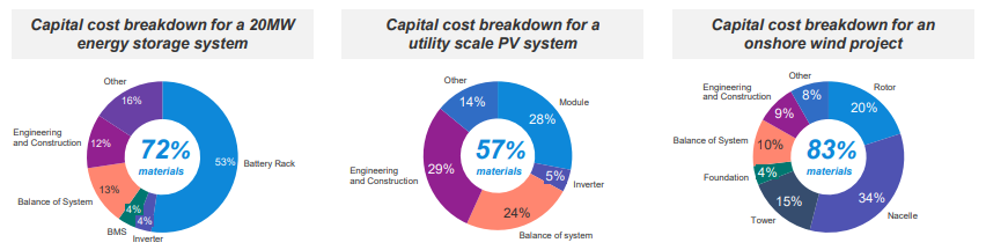
While renewable energy assets don’t consume fuel to operate, these new energy facilities require more upfront materials than their fossil predecessors. Onshore wind plants require nine times the minerals compared to gas-fired power plants, and standard 2 MW wind turbines require 400 tons of concrete, iron and steel. The majority of the lifetime costs for wind turbines – and the majority of capital costs for all renewable assets – are the materials required to build them.
The scalability solution
Energize has been evaluating the construction space for several years through the lens of infrastructure and renewable energy development. When material distributors and subcontractors reach a certain volume of projects, scale becomes difficult. The back-office functions of finance, accounting and payment compliance become particularly strained. Material suppliers and contractors get bogged down by notices, RFIs, deadlines, and invoices that are required for these construction firms to function. According to contractors and material suppliers, bandwidth becomes constrained once the volume of notices and payments exceeds 30 per month. These processes will buckle under the speed and volume required to enable the energy transition and U.S. infrastructure buildout.
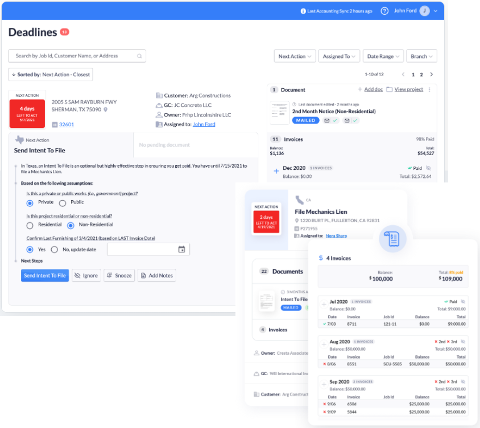
Handle helps material suppliers and specialty contractors solve these broken processes at scale. By automating (historically paper-based) notices, deadlines, RFIs and invoices, Handle enables the efficient flow of materials, saving both time and money across the construction value chain. These savings allow more labor and materials to be provided to job sites and cost-effective renewable energy assets to be constructed at pace. Additionally, Handle protects the payment rights of small businesses and contractors by ensuring that complex liens are valid and cash flow issues don’t threaten livelihoods. With Handle, construction payments and lien management are transformed into digital, traceable and sustainable processes.
What’s next: industry-specific growth
After graduating Y-combinator in 2019, Handle co-founders Patrick Hogan, Chris Woodard and Blake Robertson have continued to build a world-class product for construction payments and payment compliance.
Having grown up in the family’s lumber business, Patrick was familiar with the inefficiencies and soft costs that have historically burdened construction companies. Both material suppliers and contractors needed a more efficient way to protect their payment rights and streamline their payment processes. With a deep understanding of the pain point, the founding team set out to continue to create a valuable solution for their customers. Today, the biggest names in construction trust Handle to manage billions of dollars in invoices through the platform. These customers have decreased DSO (days sales outstanding) by 20 percent, saved 47 hours per employee per month, and improved project data on every job.
Handle and Energize see a massive market opportunity for software to automate administrative functions within construction. With the Series A raise, Handle plans to scale sales and marketing as well as expand product functionality with additional products.Energize is excited to bring our network across construction material suppliers, renewable EPCs, and electrical distributors, as well as our experience scaling SaaS companies. We’re thrilled to partner with Patrick, Chris, Blake and the broader Handle team!
Yesterday – after years and years of posturing – the SEC released guidelines for their first material climate-related disclosures. A link to their summary can be found here: https://www.sec.gov/files/33-11042-fact-sheet.pdf
Late last year Team Energize hired Lauren Densham as our Head of Impact and ESG. After reviewing the facts from the announcement she shared the following review with our team and I thought it was a great summary,
My immediate two cents:
They don’t mention TCFD but the disclosure requirements are largely aligned to what TCFD requires. Starting in 2023 (for big companies) and starting in 2024 (smaller companies) companies must disclose:
Plans for assessing and managing exposure to physical and transition risk (including strategy and governance)
Carbon footprint of operations
Scope 1
Scope 2
Scope 3 (where material, or the company is setting Scope 3 targets) – I’m sure there will be much debate on what constitutes “material”
If the company has set a net zero or other climate goal they need to report on how they plan to meet it and their progress to date in doing so
Other interesting pieces:
They are requiring that companies have 3rd party assurance on climate disclosures starting in 2024 and increasing in scope to 2026 – This is a big deal. A very small percentage of companies have any assurance on their data. This will be gold rush for firms that offer this service (e.g. Big 4)
They are also asking for more detail about the use of RECs and offsets in meeting emissions targets, there will likely be increased scrutiny here
They are not requiring that companies use scenario analysis but that they need to disclose their methodologies if they do
In line with current practice, the regulations are focused on the risk of climate change to a company’s operations rather than the risk of the company’s operations to the climate (the latter is called double materiality). There has been a lot of talk about double materiality in the EU, not yet in the US.
They are asking for companies to disclose the climate risks and assumptions they have used their financial statements vs what is in the climate reporting (believe this is a move to get companies to more closely align the two)
I think pt #4 is a great reminder for anyone new to climate-related investing. The SEC’s concern is on business performance FROM climate change… not necessarily a businesses impact ON climate change. Sure they will start being more critical of offsets (good for our investment into NCX) but only to the extent companies have volunteered to hit targets or for the required subset of industries.
At Energize we have made a number of investments that are aligned to greater climate and risk transparency. And specifically, few firms in the world are as well positioned as Jupiter Intelligence to provide climate risk analysis. Led by Rich Sorkin, Jupiter shows which assets within a company are exposed to climate risks, and that data is what the SEC wants documented and assured. We led their Series B in 2019 and believe Jupiter is a generational company… and I am glad the market is beginning to realize the company’s potential.
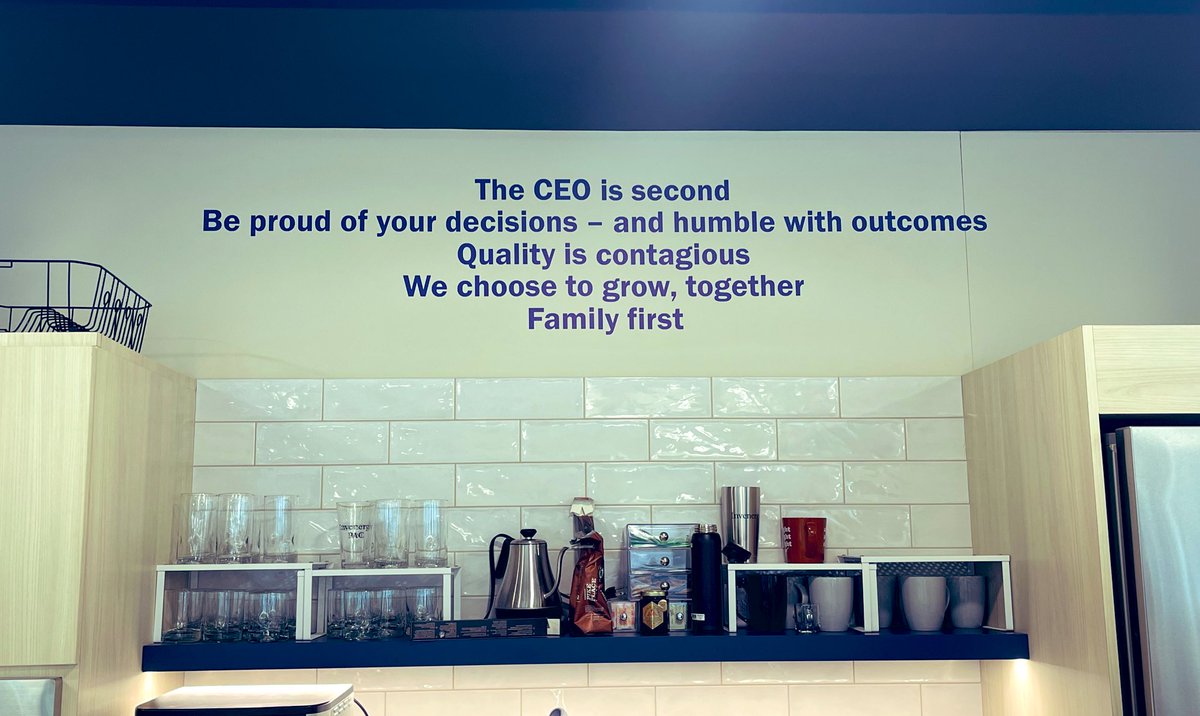
Energize has an Order of Operations and a Standard of Excellence.
I brought these concepts from my days as an operator – these key phrases help define what is important and ultimately what we believe determines long-term success here at Energize. We put them on our kitchen wall in our new office. I really like how forward we make these statements to our network.
The final statement here is “Family is First”. Earlier this week the Tough family welcomed our third child. This alongside three new deal announcements! It is a busy time but time for family. I am going to be offline here a bit – see you soon!
Yesterday we announced our growth equity investment into Aurora. We launched our growth platform because we listened to our entrepreneurs and ecosystem: our ongoing capital and time investment is a signal of belief and strength in the team and market. The Energize team aims to be a real partner along the journey delivering strategic insights and commercial advancements alongside our capital investments.
Our journey with a company usually starts much much earlier in the company’s life. We tend to invest at the inflection of commercialization – when we believe we have a “secret”. We leverage our market access and investment experience to identify the leading companies and then go all-in on supporting their growth. Our investment process begins with a research deep dive where we look to uncover how digital solutions will accelerate the sustainability movement. In 2021, Juan and Eileen led our team effort on a supply chain visibility deep dive. Today we announce the first investment from that process!
–
Energize Ventures is excited to announce we are leading the $10 million Series A investment in Sourcemap, joined by existing investor E14 Capital. Sourcemap is an expert-developed software platform providing end-to-end supply chain traceability to a wide variety of industries, from food and agriculture to luxury goods. Energize Ventures partner Juan Muldoon will join the Sourcemap board of directors, and principal Eileen Waris will join as a board observer.
Supply chain traceability is becoming table stakes
The recent spotlight on global supply chains has exposed what many insiders have long known to be true—the goods and materials we useevery day depend on a dense yet fragile web of providers that can be difficult to track and trace. With global supply chain disruptions and regulatory crackdown on social and environmental implications at an all-time high, supply chain visibility is now of utmost importance to business operations. From chip shortages to commodity price spikes, procurement departments are facing new challenges every day – and many of them culminate at the border. In 2020 Customs and Border Protection detained $50M worth of goods at the border. In 2021, that number grew to $486M, and the U.S. is already on track to exceed $2B in goods detained this year. With the latest ban on all imports from Chinese manufacturing hub Xinjiang, these problems are not likely to improve any time soon.
The root cause of many of these challenges can be pinned down to lack of visibility and understanding of global supply chains. Businesses cannot foresee disruptions in their supply chains until they have a more complete picture of who their suppliers (and their suppliers’ suppliers) are. More andmore, companies are seeking solutions that help them map and manage their supply chains, from direct suppliers all the way down to the raw material. To contextualize the complexity of this task consider this—a major CPG manufacturer might have anywhere from 5,000 to 15,000 direct suppliers. Each of those suppliers has hundreds of their own suppliers. As companies try to map down to the source of raw material, the number of suppliers becomes dizzying.
This is where Sourcemap comes in. Sourcemap’s software platform digitizes end-to-end supply chain due diligence and customs compliance, enabling an unprecedented level of enterprise observability. Their universal ETL (extract-transform-load) data platform enables source-to-store traceability for any physical product. Sourcemap uses proprietary algorithms informed by decades of data to detect human rights violations, fraud, waste, and other risks throughout the supply chain. Customers across a broad swath of industries rely on Sourcemap’s solution to improve sustainability efficiency, resilience, and competitiveness.
The energy transition calls for a more transparent supply chain
As the race to decarbonize accelerates, the buildout of renewable energy infrastructure will require significant investment – to the tune of $4 trillion by 2030. Supply chain plays a critical role in the deployment of the next generation of energy. Why? An energy system powered by clean energy is fundamentally different from one powered by fossil fuels. The volume and type of materials needed to build and maintain gas plants and coal-fired power stations have little in common with those used in the deployment of solar PV and electric batteries. Displacing existing energy infrastructure with renewable energy assets will require further development of new supply channels in addition to higher upfront materials costs, even though the variable costs are significantly lower. With this shift comes a slew of new challenges related to responsible sourcing.
The renewable energy industry is well-aware of these challenges and prepared to face them head-on by investing now in solutions that help ensure their supply chains are resilient and responsible. We see a direct opportunity for Sourcemap’s traceability software platform to accelerate the deployment of renewable energy by helping developers and operators gain line of sight into their supply chains and address potential disruptions before they happen, all while ensuring environmental and social sustainability remains at the forefront.
Expert-led team primed for expansion
Supply chain compliance is not a space for tourists. And the team behind Sourcemap are no tourists. CEO Leonardo Bonnani has assembled a team of missionaries that have spent over a decade with boots on the ground, collecting data on the world’s most complex supply chains—from cocoa to conflict minerals. With minimal outside capital, they’ve been able to bootstrap the business that has grown to serve dozens of Fortune 500 companies.
With this most recent infusion of capital, Sourcemap will continue to invest in their core business, securing their position as the leader in supply chain transparency for food and CPG brands. As an investor, we will also support two major growth initiatives: expanding Sourcemap’s presence in Europe by building out their new Paris office and developing their offerings across new verticals including energy, auto, and pharma.
Today marks my 5th anniversary of working at Energize. In 3 months it’ll be the longest tenure of my professional career, then surpassing my time at Choose Energy. I loved my time at Choose- I learned from the best and learned what decisions really mattered. I learned from a great leader in Jerry Dyess about working with every level of the company and staying grounded amidst the highs and lows of entrepreneurship.
This 5 year run at Energize has a slightly different feel. When operating a (non-IPO) startup you generally know the path to exit is 4-7 years. With Energize I realistically think I’ll be here the rest of my career. The team is too good. Our opportunity so available. The tailwinds towards digitization and sustainability so strong. The entrepreneurs and talent focusing on these solutions so promising.
We’ve gone from 1 to 20 portfolio companies since I joined. From 3 to nearly 20 great employees. In 2017 we wouldn’t have our first close – a $50M one- for 4 more months. We now have over $750M of capital under management and this quarter we are investing $100M into a single company. Our companies are delivering tremendous financial and impact returns.
I’m excited for the next 5 years and to share those updates with you all. The stakeholders we have on board (employees, entrepreneurs, LPs) are going to take us to entirely new levels.